
The name Sanahin literally translates from Armenian as "this one is older than that one", presumably representing a claim to having an older monastery than the neighbouring Haghpat Monastery. The two villages and their monasteries are similar in many ways, and lie in plain view of each other on a dissected plateau formation, separated by a deep "crack" formed by a small river flowing into the Debed river.
Sanahin Monastery
Sanahin Monastery is an Armenian monastery founded in the 10th century in the Lori Province of Armenia.
As with Haghpat, Sanahin is frequented by an increasing number of tourists, due to its recent inclusion on the itineraries of a great number of Armenian tour agencies, the beauty of its monastery complex matching that of Haghpat's. The complex belongs to the Armenian Apostolic Church with numerous khachkars (stones with elaborate engravings representing a cross) and bishop grave sites scattered throughout it.
The monasteries are UNESCO sites
Click on any of the thumbnails to get a bigger version of the picture
 |
 |
 |
 |
 |
 |
 |
 |
 |
 |
 |
 |
 |
 |
 |
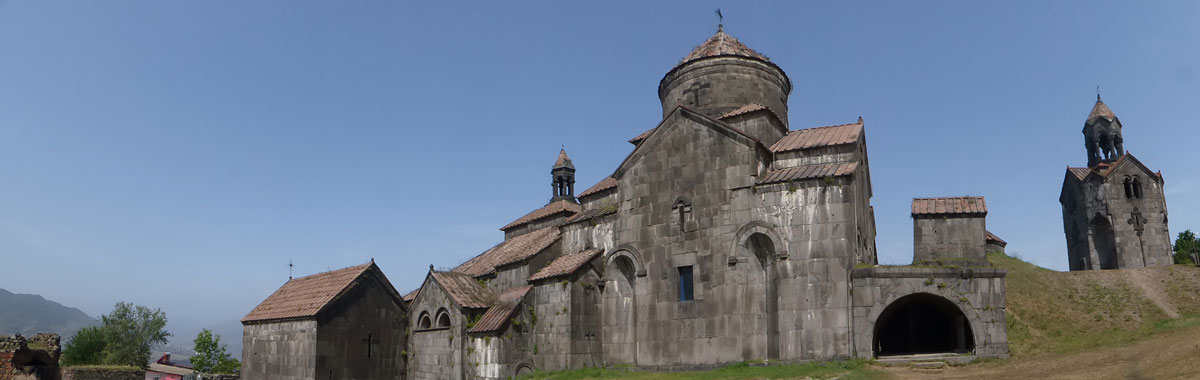
Haghpat Monastery
The monastery was founded by Queen Khosrovanuysh, wife of the Bagratid king Ashot III, probably in 976. The nearby monastery at Sanahin was built around the same time.
The location of Haghpat Monastery was chosen so that it overlooks the Debed River in northern Armenia's Lori region. It was built, not on a peak, but halfway up a hillside on a site chosen to afford protection and concealment from prying eyes and also in response to a kind of monastic humility. It is built on a verdant promontory located in the middle of a mountain cirque, which is often wreathed in clouds. A peak on the opposite side of the river is over 2,500 meters high. The monasteries of northern Armenia are not isolated, unlike their counterparts in the country's arid regions. They were built in a village environment and Haghpat is surrounded by many hamlets.
The largest church in the complex, the Cathedral of Surb Nishan, probably begun in 976, was completed in 991 by king Smbat. It is a typical example of tenth century Armenian architecture, its central dome rests on the four imposing pillars of the lateral walls. The outside walls are dotted with triangular recesses. A fresco in the apse depicts Christ Pantocrator. Its donor, the Armenian Prince Khutulukhaga, is depicted in the south transept (a transversal nave intersecting the main nave). Apart from one or two minor restorations carried out in the eleventh and twelfth centuries, the church has retained its original character.
There are several other structures at the site as well. There is the small domed Church of Sourb Grigor (St. Gregory ) from 1005. Two side chapels were added to the original church; the larger one built in the beginning of the 13th century and the smaller, known as "Hamazasp House", built in 1257. In 1245, a three-story tall free-standing bell tower was constructed. Other 13th century additions include the chapel of Sourb Astvatsatsin, the scriptorium, and a large refectory which is outside the monastery limits.
There are also a number of splendid khachkars (cross-stones) of the 11th-13th centuries standing on the territory of the monastery, the best known among them is the "Amenaprkich" (All-Savior) khachkar which has been standing since 1273.
The monastery has been damaged many times. Sometime around 1130, an earthquake destroyed parts of Haghpat Monastery and it was not restored until fifty years later. It also suffered numerous attacks by armed forces in the many centuries of its existence and suffered from a major earthquake in 1988. Nevertheless, much of the complex is still intact and stands today without substantial alterations.
Described as a "masterpiece of religious architecture and a major centre of learning in the Middle Ages", Haghpat monastery, together with Sanahin monastery, was placed on UNESCO's World Heritage List in 1996.

Click on any of the thumbnails to get a bigger version of the picture
 |
 |
 |
 |
 |
 |
 |
 |
 |
 |
 |
 |
 |
 |
 |
 |
Tavern Atorick
Lunch beside the river. the food is not bad, but not gourmet, at this very good lunchtime stop
But there are two reasons for you to stop here for lunch. Firstly it is very convenient if you are visiting the monasteries in the area. Secondly, it is a really nice location right on the river. A few kms down the road (and out of sight of the restaurant) there is also a fantastic example of the demise of the Soviet empire with an enormous abandoned industrial complex

Click on any of the thumbnails to get a bigger version of the picture
 |
 |
 |
Alaverdi Copper Mine
We passed this masterpiece of a Soviet brutal industrial landscape. It is a copper mine which is running on a low capacity. The noxious fumes have now been vented to the top of the mountain via a flat chimney. The warehouses and factory buildings are mainly abandoned. Our driver, guide, and probably all my travelling companions thought I was nuts wanting to stop for this photo, but it sums up the problems of a centralised command economy in Soviet days, and the consequences of its demise
This was Alaverdi, where we could observe the effects of the collapse of the Soviet Union. The town centre was dominated by a semi-functional copper mine, which was now jointly operated with a Greek company. Only tumbledown, plundered and empty production facilities occupying a vast territory in the town are testimony today to the town’s once industrial glory. The current image of the town is reflected in the sky in the form of a thick layer of dust formed out of copper smelting plant emissions and waste. Despite warnings by environmentalists that the situation in the town is critical, that it is the cause of respiratory diseases, tumours, the people in Alaverdi skillfully circumvent these views and have their own justification. “It was worse in the Soviet times, there was no air to breathe, now it has become a bit better. But what should we do? This is our job. Should we work? If the factory closes down and 600-700 people have to leave Armenia, what will be then?” says 53-year-old Alaverdi resident Suren Sargsyan, who also works at the local plant.

 |
 |
 |
 |
Then back to Yerevan with a stop for buns en-route
Click on any of the thumbnails to get a bigger version of the picture
 |
 |
 |
After an overnight in the Tufenkien Hotel once more, we hit the road for Matenaderan Museum where Theo was well known