

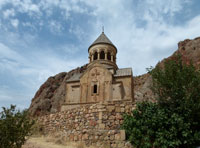
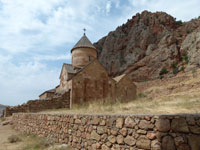
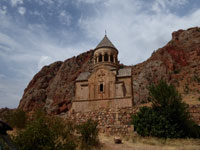
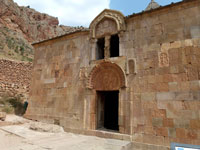
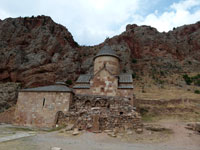
Noravank is a 13th-century Armenian monastery, 122 km from Yerevan in a narrow gorge made by the Amaghu River, near the town of Yeghegnadzor, Armenia. The gorge is known for its tall, sheer, brick-red cliffs, directly across from the monastery.
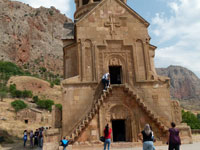
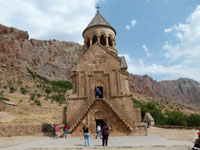
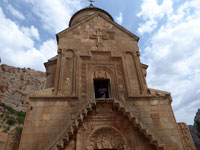
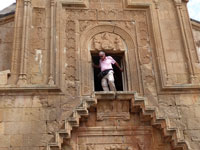
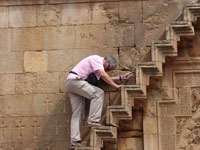
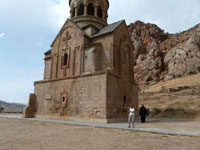
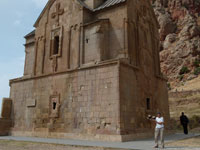
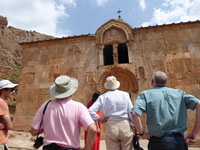
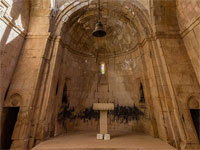
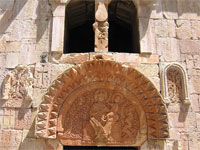
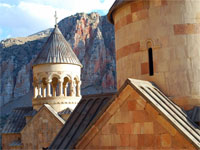
The monastery is best known for its two-storey Surb Astvatsatsin (Holy Mother of God) church, which grants access to the second floor by way of a narrow stone-made staircase jutting out from the face of building. The monastery is sometimes called Noravank at Amaghu, with Amaghu being the name of a small and nowadays abandoned village above the canyon, in order to distinguish it from Bgheno-Noravank, near Goris. Surb Astavatsatin Church is the most striking of the three churches at the Noravank Monastery complex. It was built for prince Burtel Orbelian, who governed in Syunik in the early-mid 14th century. You can go inside the church, but to get there, you have to climb an extremely narrow staircase with no handrail. To do this, you really do not want to suffer from vertigo, as to transit from the narrow stairs to the top entry door has to be accomplished without any rails and but muscle power alone.
In the 13th–14th centuries the monastery became a residence of Syunik's bishops and, consequently, a major religious and, later, cultural centre of Armenia closely connected with many of the local seats of learning, especially with Gladzor's famed university and library.
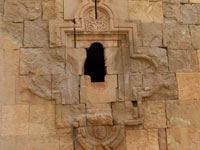
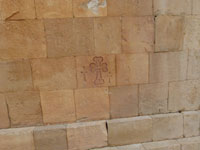
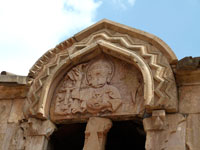
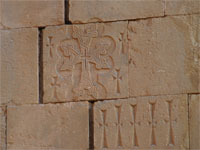
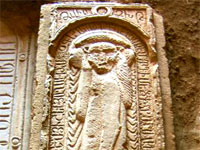
The monastic complex includes the church of S. Karapet, S. Grigor chapel with a vaulted hall, and the church of S. Astvatsatsin (Holy Mother of God). Ruins of various civil buildings and khachkars are found both inside and outside of the compound walls. Noravank was the residence of the Orbelian princes. The architect Siranes and the miniature painter and sculptor Momik worked here in the latter part of the thirteenth and early fourteenth century.
Click on any of the thumbnails to get a bigger version of the picture
 |
 |
 |
 |
 |
 |
 |
 |
 |
 |
 |
 |
 |
 |
 |
 |
 |
 |
 |
 |
 |
 |
 |
 |
 |
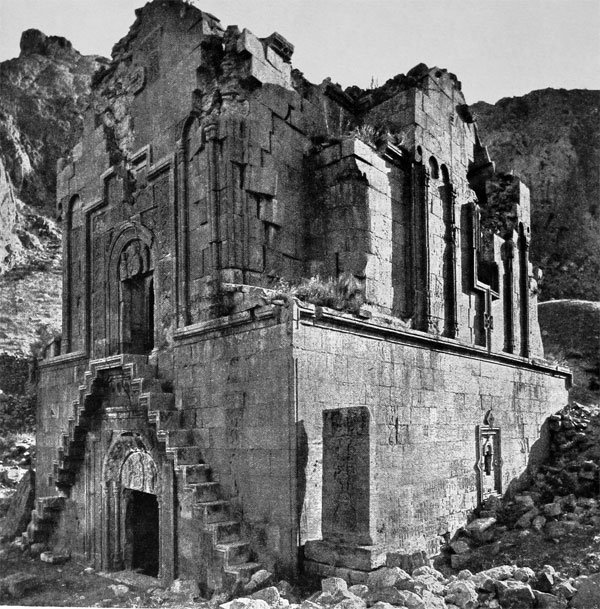
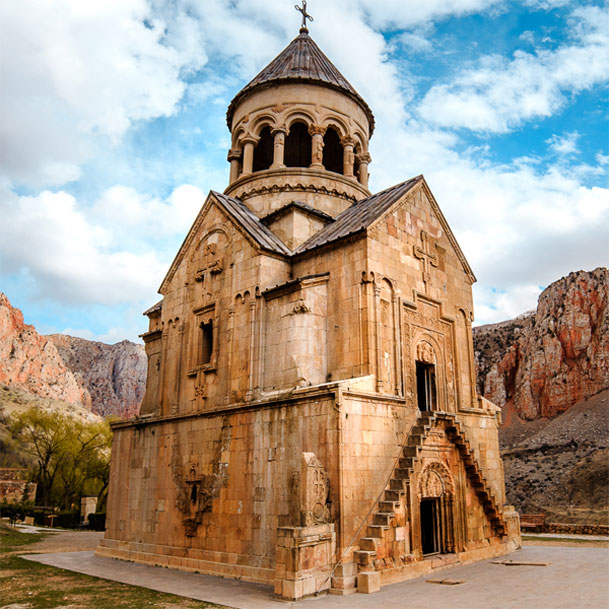
Showing the amount of restoration to Novavank since the early 1900s