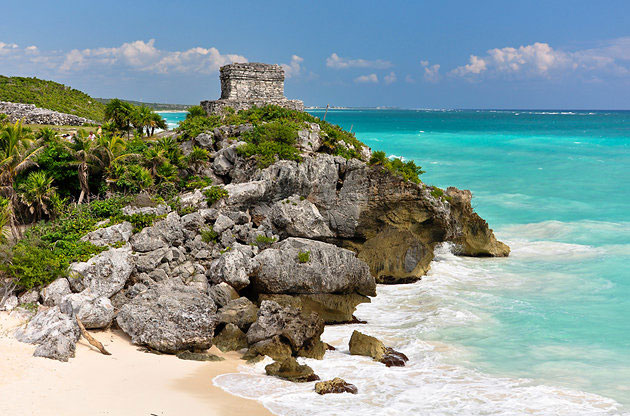
The tourist destination is now divided into four main areas: the archaeological site, the pueblo, the zona hotelera and the biosphere reserve of Sian Ka'an.
Ruinas Mayas de Tulum. Tulum archaeological site is relatively compact compared with many other Maya sites in the vicinity, and is one of the best-preserved coastal Maya sites. Its proximity to the modern tourism developments along the Mexican Caribbean coastline and its short distance from Cancún and the surrounding "Riviera Maya" has made it a popular Maya tourist site in the Yucatan. Daily tour buses bring a constant stream of visitors to the site. The Tulum ruins are the third most-visited archaeological site in Mexico, after Teotihuacan and Chichen Itza. It is popular for the picturesque view of the Caribbean and a location just 128 km (80 mi) south of the popular beach resort of Cancún. A large number of cenotes are located in the Tulum area such as Maya Blue, Naharon, Temple of Doom, Tortuga, Vacaha, Grand Cenote, Abejas, Nohoch Kiin and Carwash cenotes and cave systems.
Ancient Tulum, perched on top of a 12-meter-high cliff overlooking the white sandy beaches of the Caribbean Sea, is the only fortified Mayan town by the coast. Bounded on the landward side by a wall, Tulum is one of the most fascinating ruined cities on the Yucatán Peninsula, thanks to its unique cliff-top position and wall paintings. While not much is known of its past, its name is Mayan for fortification, suggesting it once held military significance. Dating from the Maya Late Post-Classic period after AD 1200, the site's most important buildings were probably not erected until 1450, just 68 years before members of a Spanish expedition became the first Europeans to see the fortification. The city appears to have been inhabited right up until 1544, when the Spanish conquered the northeast of Yucatán, and towards the end of the last century, during the Caste War, when Maya Indians again barricaded themselves at Tulum. Perfectly positioned just an hour or so from the resort destinations of Cancún and Playa del Carmen, Tulum is a must-see tourist attraction when visiting the Mayan Riviera.
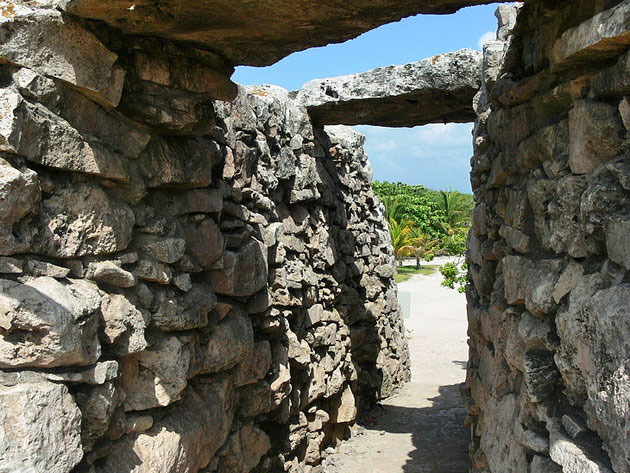
The relatively small area occupied by the ruins of Tulum is surrounded on the landward side by a fortified wall, an enclosed area measuring 380 meters by 65 meters. The stone wall itself was originally between three and five meters high and, on average, seven meters wide and contained five exit points protected by stone slabs - features that suggest Tulum also included a dwelling area. A circular walkway protected by a parapet led along the length of the wall, and at each of the two inner corners was a small temple, also used as watchtowers.
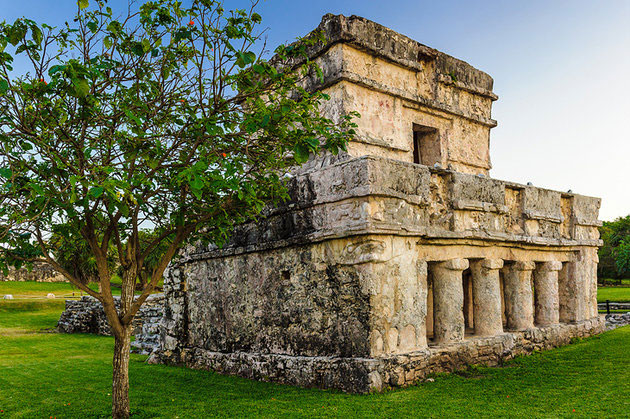
The most important of Tulum's buildings is the Temple of the Frescoes (Templo de los Frescos, or Edificio 16). Standing in the middle of the walled area on an east-west axis, the building was constructed around 1450 and built over on several occasions. The only ground floor room has an entrance on the west side that is divided up by four columns, above which is a double ledge sectioned off by three niches, the central one containing a stucco sculpture of the God Descending, while the others are decorated with reliefs depicting seated figures with elaborate headdresses. The corners of the ledges consist of large bas-relief masks that were once painted and depict Itzamná, the old Sky God revered by the Yucatán Mayas. Over the door of the upper floor is a niche with the remains of a stucco relief representing the God Descending, and the wall of the interior room is decorated by interesting codex-like paintings depicting other Mayan gods. In the upper section, two representations of Itzamná face one another, flanked by the rain god Chac, while the central part of the frescoes depicts the moon and fertility goddess Ixchel. Also of interest, in front of the temple on an altar, stands a nearly one-and-a-half-meter-high stela bearing a post-Classic Maya calendar for the year 1261.
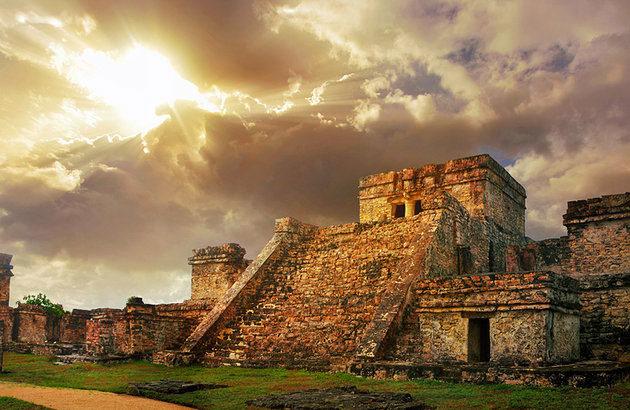
The largest and most striking building on the site is the Castillo (Edificio 1), at the eastern end on the cliff-edge overlooking the sea. Believed built during three separate periods, this large structure is notable for the broad steps leading to a terrace on which the two-roomed temple stands, along with a stone used as an altar for human sacrifices. The entrance to the temple is subdivided by two serpent columns, and in the niche above the central door, a stone figure can be seen representing the God Descending.
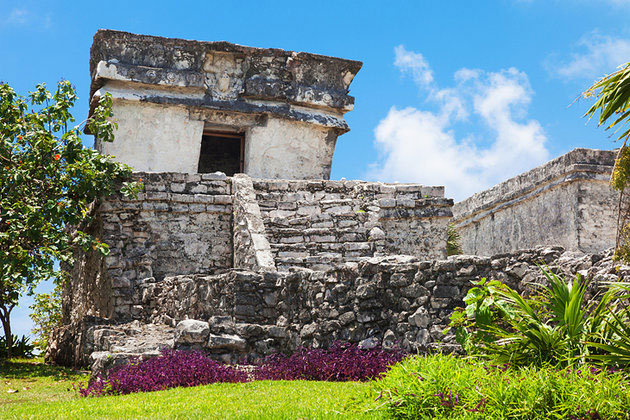
Directly north of the Castillo is the Temple of the God Descending (Templo del Dios Descendente), erected on top of an older structure and notable for the fact its walls taper downwards, a method of building believed to provide stability. Possessing a single room, the temple's interior includes interesting features such as the niche over the entrance containing a stucco sculpture of the God Descending with wings on its arms and shoulders, as well as a bird's tail. This winged figure has various interpretations, including a swooping bee, the evening star, the setting sun, or even lightning. Also of interest is the Temple of the Initial Series (Templo de la Serie Inicial, Edificio 9) named after a stela found here that was dated as AD 564 and which now resides in the British Museum in London
Sian Ka'an is a biosphere reserve in the municipality of Tulum in the Mexican state of Quintana Roo. It was established in 1986 and became a UNESCO World Heritage Site in 1987. With the participation of scientists, technicians, students, fishermen, farmers, rural promotors and administrators, together with regional and international partners, have successfully carried out more than 200 conservation projects basing all conservation actions on scientific and technical information for planning and implementing environmental policies and the proposal of viable solutions for sustainable use of natural resources and focusing their efforts established within eight protected natural areas that include the reefs of Banco Chinchorro, and Xcalak at South of Quintana Roo, Sian Ka'an Biosphere Reserve, Cancun, the island of Cozumel that is located in front of Xcaret and Contoy Island up North, covering 780,000 acres (3,200 km2). These areas lie in parts of all seven Caribbean Sea coastal municipalities of the state, with the largest part being in eastern Felipe Carrillo Puerto Municipality, where the vast majority of Sian Ka'an Biosphere Reserve lies. Part of the reserve is on land and part is in the Caribbean Sea, including a section of coral reef. The reserve has an area of 5,280 km2. The reserve also includes some 23 known archaeological sites of the Maya civilization including Muyil. Within the Amigos de Sian Ka'an project objectives are the identification, protection and management of additional areas with high biodiversity value as well as those critical for maintenance of the life cycles of endangered, threatened and migratory species in the Riviera Maya and providing environmental education through books, journals and pamphlets and giving technical assistance and training to Mayan communities working with ecotourism.
Hotel
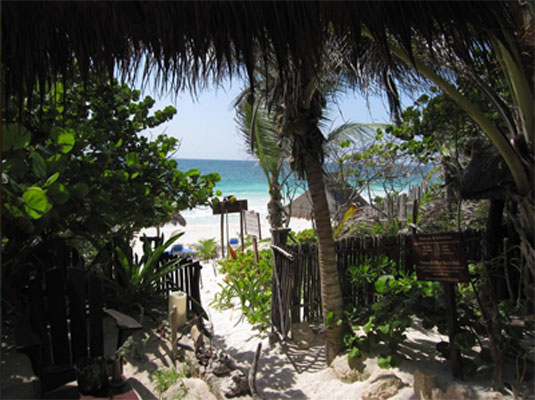
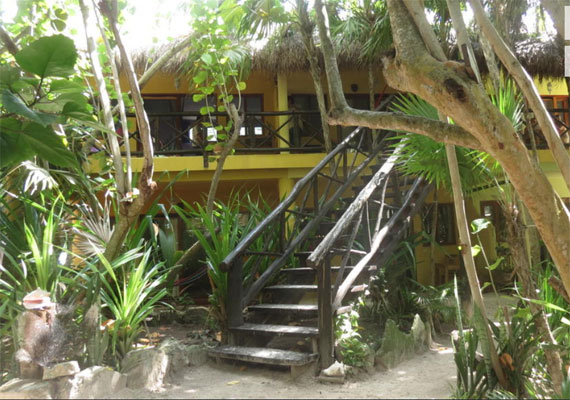
Dos Celbas Posada Ecologica . On Booking.com with 9.3. and Their Own Web Site. 6 rooms. Set on a private area of Tulum Beach, this eco-resort offers a typical Temazcal sauna, yoga classes and a range of massages. It is located next to the beautiful Sian-Ka'an Biosphere Reserve. The thatched bungalows have fans, bathroom and views of the gardens. The bungalows are powered by solar panels and wind energy. They have traditional décor and come with mosquito nets. Dos Ceibas Posada Ecológica is surrounded by tropical gardens, including 2 Ceiba trees, known as the sacred trees of the ancient Mayas. As an activity, the hotel organizes lessons of sacred dance, meditation and full moon Mayan ceremony. The lobby offers a free WiFi zone and a 24-hour reception. Staff can arrange hiking or diving trips and organize transfers to Cancún Airport, a 90-minute drive away. The Dos Ceibas’s open-air restaurant serves simple, home-cooked food. Breakfast includes fresh coffee, fruit juices and eggs.