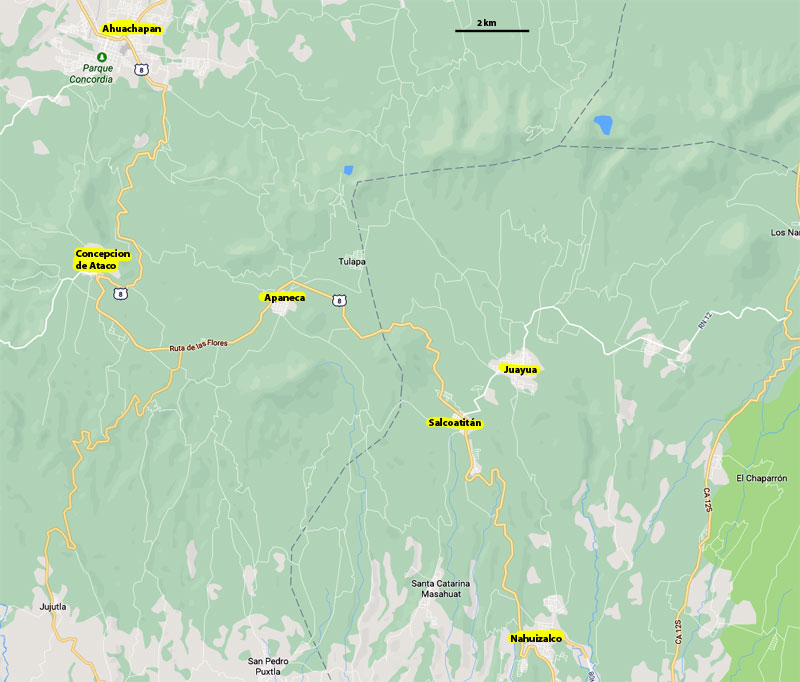
Traveling the La Ruta de las Flores, slowly and purposefully, is like a meander through the story of El Salvador. It's a searingly beautiful series of villages, each with a mix of colonial architecture in indigenous tones. Those who like the good life can feast on local food, particularly at the weekend markets, browse the craft tiendas, or undertake firsthand research into why El Salvadoran coffee is renowned across the world. If the pace is too slow, you can hit the Cordillera Apaneca, a volcanic mountain range filled with waterfalls, mountain-bike trails, and pine forest hikes where white flowers bloom in May. In 1932 this region witnessed the horrible Peasant Massacre, when mostly Nahuatl coffee farmers were slaughtered by government troops for an attempted insurrection and mass protest. The actual number of deaths still varies, but 30,000 people is a close estimate.
Beginning out of Sonsonate, La Ruta de Las Flores in El Salvador a mountainous road stretching just over twenty miles. It got its name, meaning route of the flowers, for the seasonal burst of colorful flowers that line the expanse of road between October and February. This is a great option for those looking for a day away from the surfer scene of the nearby coastal towns.Beginning out of Sonsonate, La Ruta de Las Flores in El Salvador a mountainous road stretching just over twenty miles. It got its name, meaning route of the flowers, for the seasonal burst of colorful flowers that line the expanse of road between October and February. This is a great option for those looking for a day away from the surfer scene of the nearby coastal towns.
Ahuachapán is a city in western El Salvador. The municipality has a population of 110,000 people. Situated near the Guatemalan border, it is the westernmost city in the country and is the center of an agricultural region producing primarily coffee. Ahuachapán is the site of a geothermal power plant and a hydroelectric station. The local geothermal activity produces many steam vents, visible throughout the surrounding mountains. Among other things, Ahuachapan is also the birthplace of notable Salvadoran poet Alfredo Espino and is about an hour's drive from the national wildlife park El Imposible. Near the Iglesia La Asunción, the Francisco Menéndez Park has a monument to honor General Francisco Menéndez who was president of the republic. There is a bronze plate indicating the house where he lived. One of the main attractions is the Central Plaza, which contains: the Central Park, known as Parque Concordia, surrounded by City Hall (a modern style building with a little resemblance of art deco, rebuilt after a fire in the 1950s), the town's main church, Iglesia de La Asunción, which is over 100 years old, and the Pasaje Concordia, also known as "the new place in town," that was restored in the early twenty first century and is a pedestrian-only street.
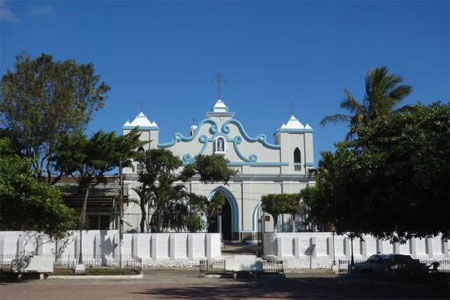
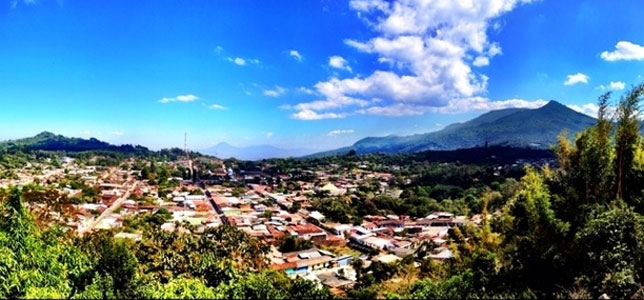
Concepción de Ataco is a city within the Ahuachapán Department, El Salvador. It has a population of 18,000 inhabitants. One of the most famous handicraft shops that has treadle looms is Diconte & Axul. This is a very colorful and striking corner which gives life to the people of Ataco, for it is out of the ordinary and traditional. Its facade shows the lines, colors and figures of the handcrafts that are inside. The shop's charismatic owners, Alvaro Orellana and Cristina Pineda Fagioli, paint each piece and, as such, they should be considered unique, a characteristics which gives them higher value. Established in an old house, dating from 1910, near the center of town. You can also see how local artisans make colorful fabrics using treadle looms, a tradition that is disappearing throughout Latin America. In Diconte & Axul you can purchase these unique fabrics from $6 to $8 a yard.
Salcoatitán is small and predominantly made up of one roadside strip. In Nahuatl, Salcoatitán means “City of Quetzalcoatl”, Quetzalcoatl being the Mayan god of wind and star of the dawn. The town’s population is almost entirely dependent upon the coffee industry. It is home to two beautiful churches, delicious pupusas, and a few handicraft shops.
Nahuizalco , of all of the stops on La Ruta de las Flores, is perhaps the most undervalued stop. Nahuizalco was a place of great significance for the Mayans and today it is one of the few pueblos in El Salvador that still clings to its ancient indigenous heritage. While it is best known for its handmade furnishings, it is also a great place to purchase other artisanal goods to bring home to loved ones. Additionally, it has a beautiful colonial church, La Iglesia de San Juan de Bautista. Constructed in 1660, it has been destroyed and reconstructed several times. It is the highlight of the town. There are also several waterfalls just outside of town, the most well-known is La Golondrinera.
Apaneca is a quiet pueblo with cobblestone streets. It doesn’t require very long to explore the town on foot but people are often compelled to stay longer because of the two nearby crater lakes, Laguna Verde (2.5 miles from town) and Laguna de las Ninfas (1.5 miles from town). Both make for a great hike for those looking for a site off the beaten path. This area is notably safe and the hikes are well marked and populated, making guides unnecessary.
Juayua is a quaint sleepy town that’s the first stop on the route. It is picturesquely nestled amongst 11 of El Salvador’s volcanoes. It is best known for its weekend food festival where people come from near and far to sample what is arguably the best national cuisine. The festival also features music in the main plaza where people crowd to eat and socialize. Additionally, the town is near the starting point for the Seven Waterfalls trek, where visitors can view seven majestic waterfalls and take a refreshingly scenic dip. Held every weekend in Juayua, the small Feria de la Gastronomia is a huge draw for both locals and travellers. Although some of the more unique foods are no longer easily found (such as guinea pig and snake), you'll still salivate at the barbecued meats, chorizo, shrimp sticks and fish on offer, all washed down with a cold Pilsner or hot pineapple atole. A plate from any of the colourful stalls costs around $5 and it's often a huge portion. On the day, there's a good buzz around town with entertainment (although this may consist of one odd man with a portable speaker) and craft stalls. Even if you're here when the food fair isn't on, you'll still find some of the best pupusas in the country at a couple of restaurants in town.
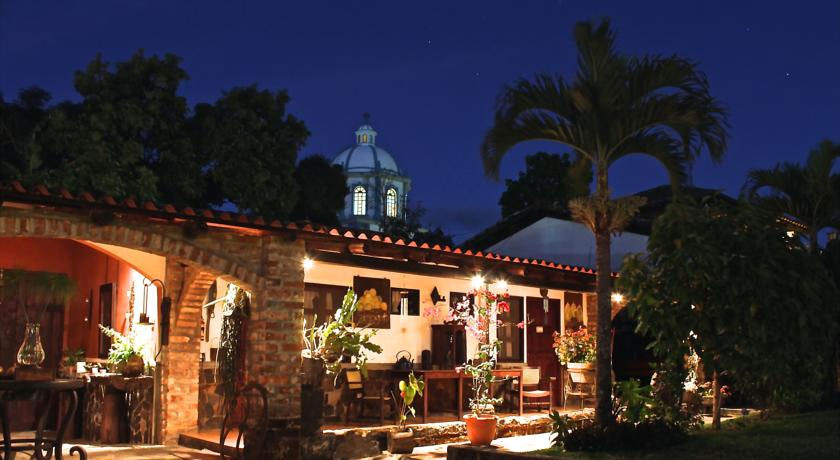
Hotel Casa de Graciela 9.6 on Booking and on Tripadvisor and hotels own web site.Offering an à la carte restaurant, Casa Degraciela - Boutique Bed & Breakfast is located in Concepción de Ataco, 10 km from Ahuachapán. Free Wi-Fi access is available. Rooms here will provide you with an iPod dock and a seating area. Featuring a shower, private bathrooms also come with a hairdryer and free toiletries. You can enjoy a garden view from all the rooms. Extras include a fan. Housed in a historic building, this property offers free breakfast included. At Casa Degraciela - Boutique Bed & Breakfast you will find a 24-hour front desk, a garden and barbecue facilities. The property also offers a shared lounge, a games room and a tour desk. An array of activities can be enjoyed on site or in the surroundings, including billiards. The property offers free parking. Ilopango International Airport is 1 hour and 35 minutes’ drive away. This property also has one of the best-rated locations in Concepción de Ataco! Guests are happier about it compared to other properties in the area.
Without a doubt one of the best hotels in El Salvador. I stayed in the suite which featured a beautiful bath and a little bar area. You walk from the busy market town into a tranquil, natural landscape and it is the perfect place to relax. Breakfast was delicious and the bed was incredibly comfortable. Staff really go the extra mile to personalize your stay. I cannot recommend the place highly enough