
Puerto Natales is the jumping off place for the Torres del Paine National Park. The Explorer arrived in the evening, but could not dock as a "misunderstanding" meant that a ship owned by the harbourmaster was occupying the reserved berth. We were zodiaced off the ship the next morning for our buses to Torres del Paine. The Explorer did manage to get a berth while we were away, as the Navimag Ferry left during the day, and we got its berth.
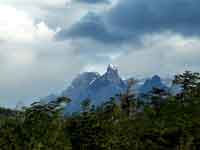
It is a fairly long 2 hour ride up to the National Park, but for much of the way you see the approaching Massif getting bigger and bigger on the horizon. It is one of the largest and most visited parks in Chile. The park averages around 150,000 visitors a year, of which 60% are foreign tourists. The Torres del Paine are the distinctive three granite peaks of the Paine mountain range or Paine Massif. They extend up to 2,500 meters above sea level, and are joined by the Cuernos del Paine. The well-known lakes include Grey, Pehoé, Nordenskiöld, and Sarmiento. The glaciers, including Grey, Pingo and Tyndall, belong to the Southern Patagonia Ice Field.
Lady Florence Dixie, in her book published in 1880, gave one of the first descriptions of the area and referred to the three towers as Cleopatra's Needles. She and her party are credited as being the first "foreign tourists" to visit the area that is now called Torres del Paine National Park. Several European scientists and explorers visited the area in the following decades, including Otto Nordenskiöld, Carl Skottsberg, and Alberto María de Agostini. The park was established in 1959 as Parque Nacional de Turismo Lago Grey (Grey Lake National Tourism Park) and was given its present name in 1970.
Much of the geology of the Paine Massif area consists of Cretaceous sedimentary rocks that have been intruded by a Miocene-aged laccolith. Orogenic and erosional processes have shaped the present-day topography, and glacial erosion is mainly responsible for the sculpturing of the massif in the last tens of thousands of years. A good example of the latter is the Cuernos del Paine, whose central bands of exposed granite contrast strongly with the dark aspect of their tops, which are remnants of a heavily eroded sedimentary stratum. In the case of Las Torres, what once was their overlying sedimentary rock layer has been completely eroded away, leaving behind the more resistant granite.
This is the second time we have visited the Park, and it is as stunning the second time as on the first
Click on any thumbnail photo to get a larger picture
 |
 |
 |
 |
 |
 |
 |
 |
A walk at Lago Grey. You cross the swinging bridge (only 5 people at a time allowed on the bridge) to get to the terminal moraine of the retreating Lago Grey Glacier - the glacier has retreated a number of miles now, and is just a speck on the horizon from the moraine. However the ice that has calved off the glacier is pushed by the strong wind to the moraine, where it can go not further, and there slowly melts
Did I say wind - yes there was an incredible strong wind which we had to battle on the return from the loop walk, and we were in danger of being blown off our feet at times - a question of holding hands and hoping for the best. The moraine was loose volcanic sand and heavy going, from there a path ran up a small island, to reach a vantage point from where you could (just) see the distant Glacier. Being overcast at the time, it did not photograph. We then took a more difficult path back along the other side of the island, before getting back to the moraine Time was a bit of an issue as were were the last of our bus, and were pushing the "get back by time" - however we did make it, without our fellow passengers being inconvenienced.
Click on any thumbnail photo to get a larger picture
 |
 |
 |
 |
 |
Lunch at Hotel Rio Serrano. You come here for the view, not the food. You would probably be better off buying just a drink and enjoying the view. We stayed here about 7 years ago, the food was bad and expensive then, and it still is when we came this year. And the hotel has grown in size somewhat in the intervening years
This time we just had a lunch buffet, including a "traditional" barbecue of lamb from an open fire that they have in the garden. The lamb was dry and tough. And the desserts in particular tasteless and uninspiring. But it is the view that you come for. The restaurant on the first floor looks straight at the massif. Mind you the bar and lounge downstairs have just as good a view. One accepts that this is "tourist land" and that tourists are milked the world over - this is as true here as any other high tourist volume destination.
For old times sake we stood on the balcony of the corner room that we had before and soaked in the view one more time
Click on any thumbnail photo to get a larger picture
 |
 |
 |
 |
 |
 |
 |
The park and its fauna. Apart from the many Guanaco that one expects to see here, we saw both Condors and Huemul (the South Andean Deer)
South Andean Deer (Huemul) Hippocamelus bisulcus Deer living in small groups in high mountain forests, near Grey lake. Feeds mainly on herbs and scrubs and reaches 85cm tall, weighing up to 100kg. Features on Chile's national coat of arms and is an endangered specie with just, depending on your source, 20 to 100 remaining in the park. One book says Even if you go to areas where there are remaining huemul populations in Chile, your chances of happening across one are still pretty slim, huemuls spend their time actively avoiding humans.
Condors . The Andean condor has a maximum wingspan of 3.2 m . We saw a couple on the ground as they scavenged the dead remains of a dead guanaco. This species is described as uncommon and probably declining, and can be found all the way down the coast of South America. There are no real statistics available on numbers, as the birds are split into groups of up to about 100 in an area
Click on any thumbnail photo to get a larger picture
 |
 |
 |
 |
 |
 |
 |
 |
 |
 |
 |
 |
 |
 |
 |
 |
 |
 |
 |
 |
Cerro Castillo . Back to the ship via Cerro Castillo, where I realised we had an enforced stop when we were driving the Carriterra Austral. The frontier post into Argentina is here, and we arrived without the correct "papers" for the rental car. We waited in the shop cum cafe for Hertz to fax them, and eventually the papers arrived and we were able to advance into Argentina. Apart from the memories, all one can say about the 'town' is that it is a small border hamlet that used to be a cattle ranch, and has a population of about 400 today.
 |
 |
 |
 |
 |
 |
The voyage on Silversea Explorer in South America